Your car brakes for what the camera sees. We aim the camera.
Lane-keep assist, automatic emergency braking, adaptive cruise — on most cars since 2018 they all look through one camera behind the windshield. Replace the glass and that camera's world shifts. Calibration puts it back to a half-degree spec, and we do it in-house, in the same visit, to your manufacturer's written procedure.
Small angle. Long lever.
Automatic emergency braking ranges cars and pedestrians through this camera. Aimed wrong, it brakes late — or for the wrong lane.
Lane-keep assist steers against the lines the camera sees. A skewed camera centers you a foot off — drivers describe it as "the car fights me."
Adaptive cruise follows the car the camera picks. Off-aim, it can latch onto the neighbor lane on curves.
Auto high-beams read oncoming headlights here too — the polite thing to keep calibrated.
None of these systems warn you they're mis-aimed. The dash shows no light for "half a degree off." That's the whole reason the calibration step exists in your manufacturer's procedure — and why skipping it to save an hour is the wrong trade.
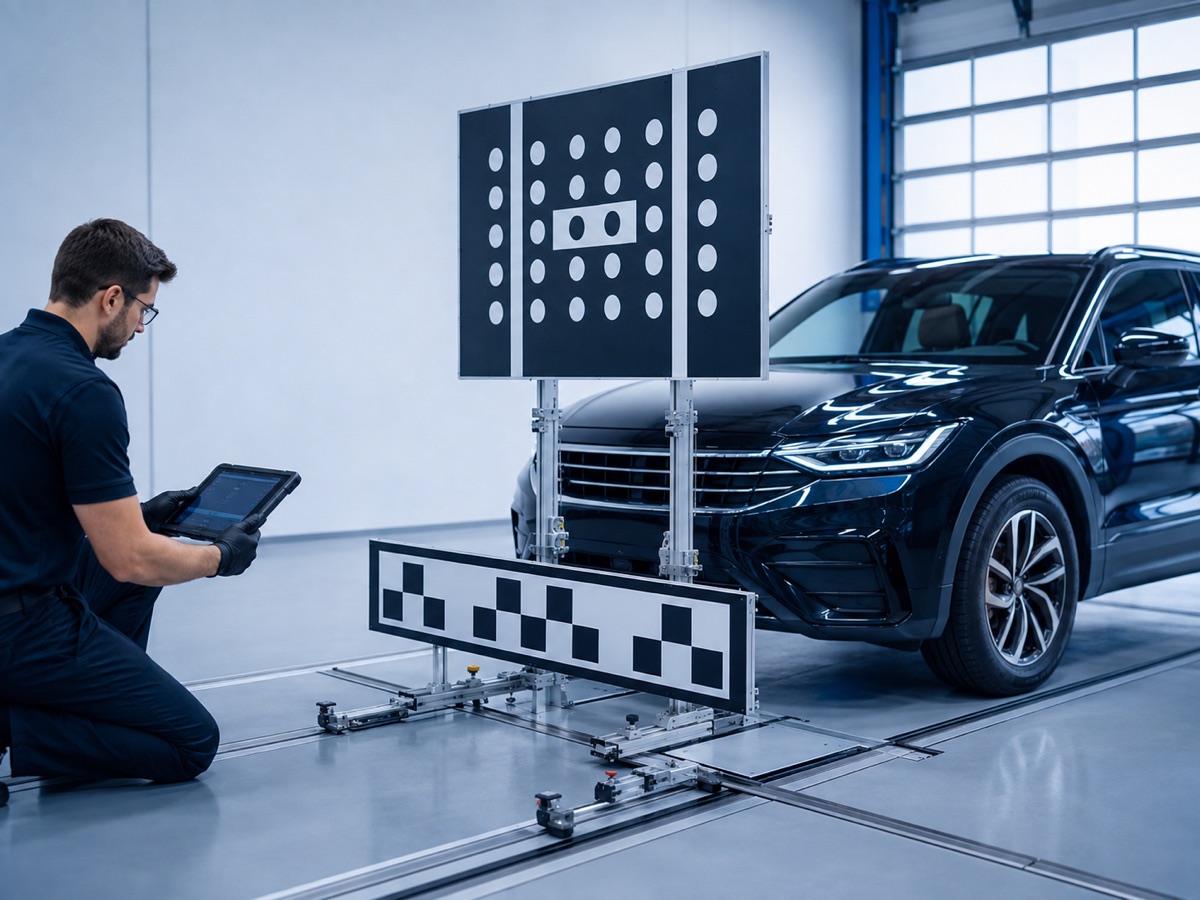
Static, dynamic, or both — the car decides.
Which calibration your car needs isn't our choice or yours — it's printed in the manufacturer's service procedure. We look it up by VIN and follow it exactly.
| Static — in the bay | Dynamic — on the road | |
|---|---|---|
| Setup | Printed targets on stands, placed to the millimeter; level floor, controlled light, tires at spec pressure, tank per spec | Scan tool connected; prescribed route at set speeds with clear lane markings |
| Duration | 30–60 minutes | 20–40 minutes of driving |
| Typically needed by | Many Toyota, Honda, Subaru, Hyundai/Kia procedures | Many Ford, GM, Mazda procedures |
| Both | Plenty of vehicles require static first, then a dynamic confirmation drive — we schedule the visit so both fit | |
| Proof | Pre-scan and post-scan reports, printed and emailed: codes cleared, calibration completed values in spec | |
Ask any glass quote this question: "who does the calibration, and do I get the report?" Some shops replace the glass and quietly sublet the calibration days later — you drive uncalibrated in between. Here it's the same visit, the same building, and the report goes in your hand.
A calibration bay is a measuring instrument.
Target-based calibration assumes the room is true. Ours is checked like a fixture: floor level surveyed, distances laid out with a laser, lighting even and shadow-free — the conditions the procedures were written for.
It's also why "we'll calibrate it in your driveway" should raise an eyebrow: static procedures can't be done to spec on a sloped drive in changing daylight. When a mobile replacement needs a static calibration, we schedule the car into the bay the same day — and say so up front.
Floor level within spec across the target field; measured, not assumed
Target distance & height set by laser to the procedure — 10 ft ± ¼ in on most layouts
Tire pressures set to placard; fuel level per procedure; cargo out of the trunk
Windshield glass variant confirmed against VIN before aiming begins
Pre-scan saved; post-scan verified in spec; both printed for the customer
Calibration questions, straight answers.
Does my car actually need this?
If it has a camera at the top of the windshield (look behind the rear-view mirror for a small housing), yes — after any windshield replacement. Text us your VIN and we'll read out exactly what your manufacturer's procedure requires before you book anything.
Another shop replaced my glass and skipped it. Can you calibrate just that?
Yes — calibration-only appointments are welcome, including glass we didn't install. It happens more than you'd think, usually after someone notices their lane-keep pulling. You get the same pre/post report.
Does insurance cover the calibration?
When the replacement is covered, the required calibration is part of returning the vehicle to spec — carriers pay it as part of the glass claim. We include it as a line item on the same claim, not a surprise invoice.
What if the calibration won't complete?
Occasionally a car refuses — a worn suspension angle, an unrelated fault code, a damaged bracket. We stop, show you the scan, and explain the fix path. What we don't do is clear codes and hope; the post-scan either shows in-spec values or the car isn't released as done.
Glass and calibration. One appointment, one report.
Send your VIN — we'll quote the glass, name the exact calibration your car requires, and book both into a single visit.