Appeal Factory · B2B SaaS · Python + React
Appeal Factory — Denial Appeals for Providers
70% of fought denials get overturned. Most never get fought.
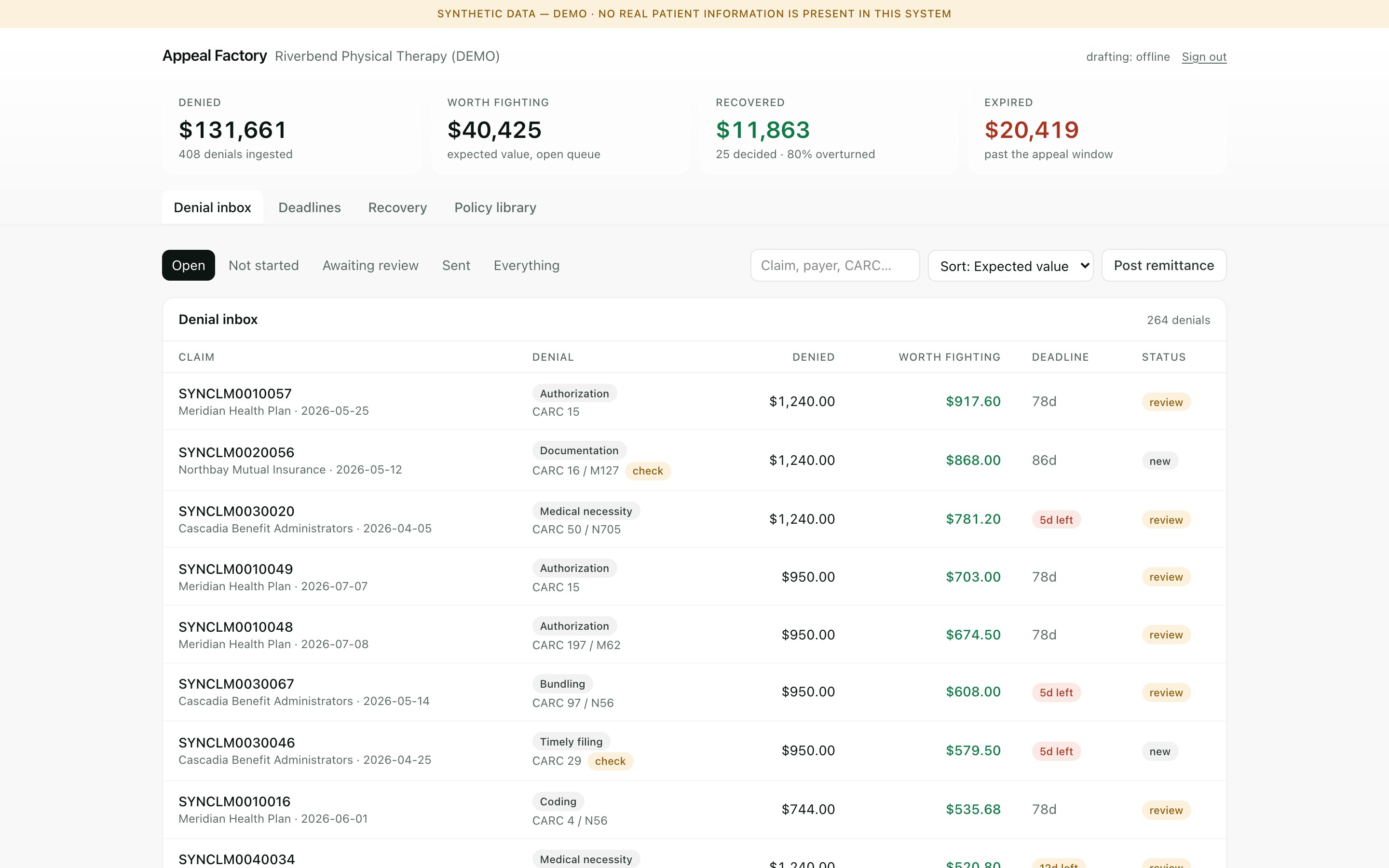
Providers spent $25.7B fighting claims adjudication in 2024, up 23% in a year, and Premier estimates about $18B of that was avoidable. Initial denial rates run around 15% — yet roughly 70% of denials that are actually appealed get overturned. The gap between those two numbers is not a clinical problem or a legal one; it is a staffing problem, and it is why 41% of providers now report denial rates at or above 10% while only 14% use AI anywhere in claims. Appeal Factory reads your remittances, classifies every denial, ranks them by what they're worth against the deadline, drafts the appeal letter grounded in that payer's published medical policy with the citations and required attachments listed, and tracks the outcome so the report is in dollars recovered rather than letters sent. A biller reviews and sends; nothing files itself. The rule the whole system is built around: if no clause in that payer's policy supports the appeal, the letter is refused rather than written — a citation that doesn't exist is worse than no letter at all.
Built for: Specialty clinics, ASCs, behavioral health and DME suppliers writing off denials they don't have staff to fight
- 835 remittance ingestion with denial classification by CARC/RARC
- Work queue ranked by expected value against the appeal deadline
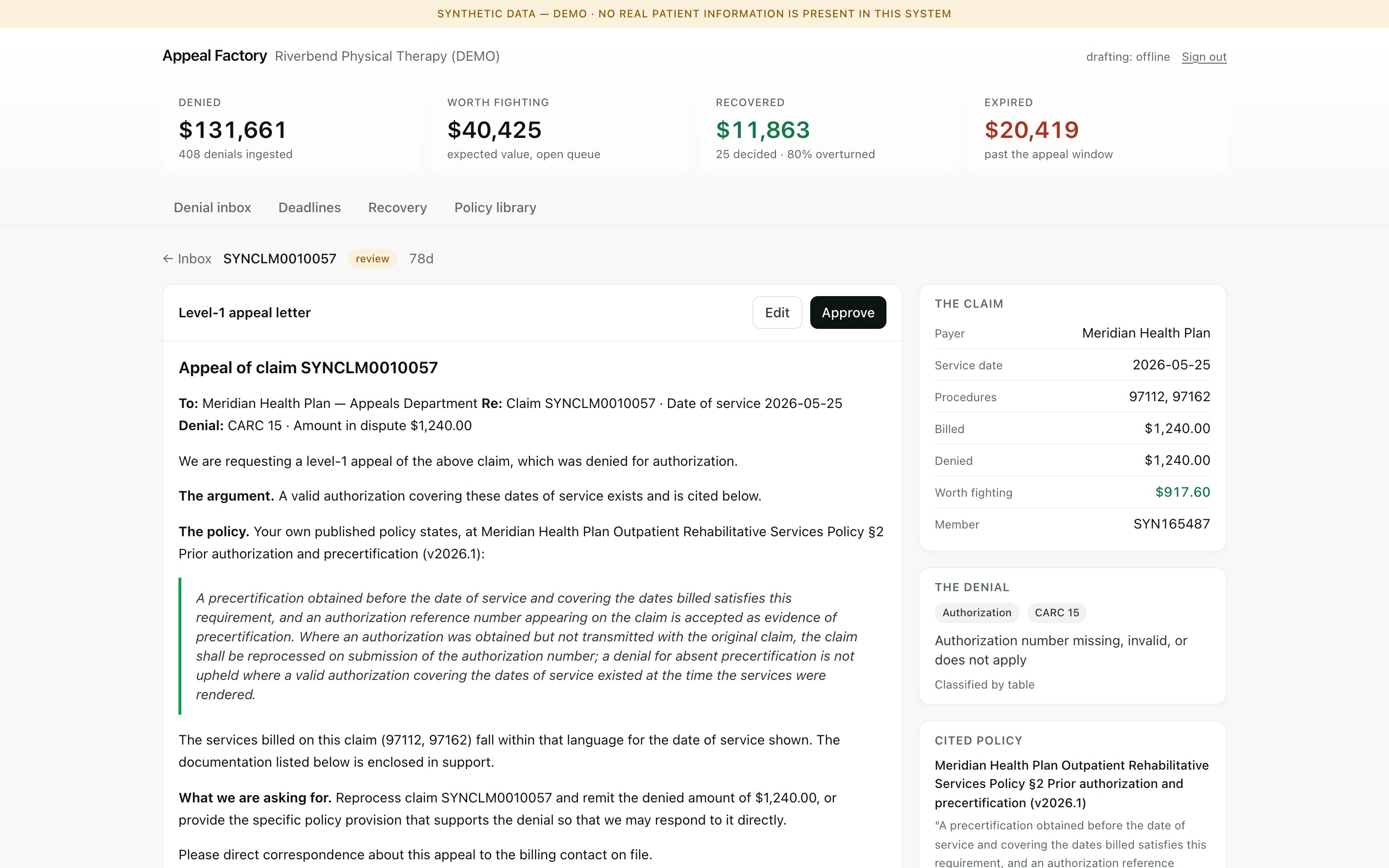
- Appeal letters drafted against the payer's own published policy — with citations
- Required-attachment checklist per denial type, so appeals don't bounce on paperwork
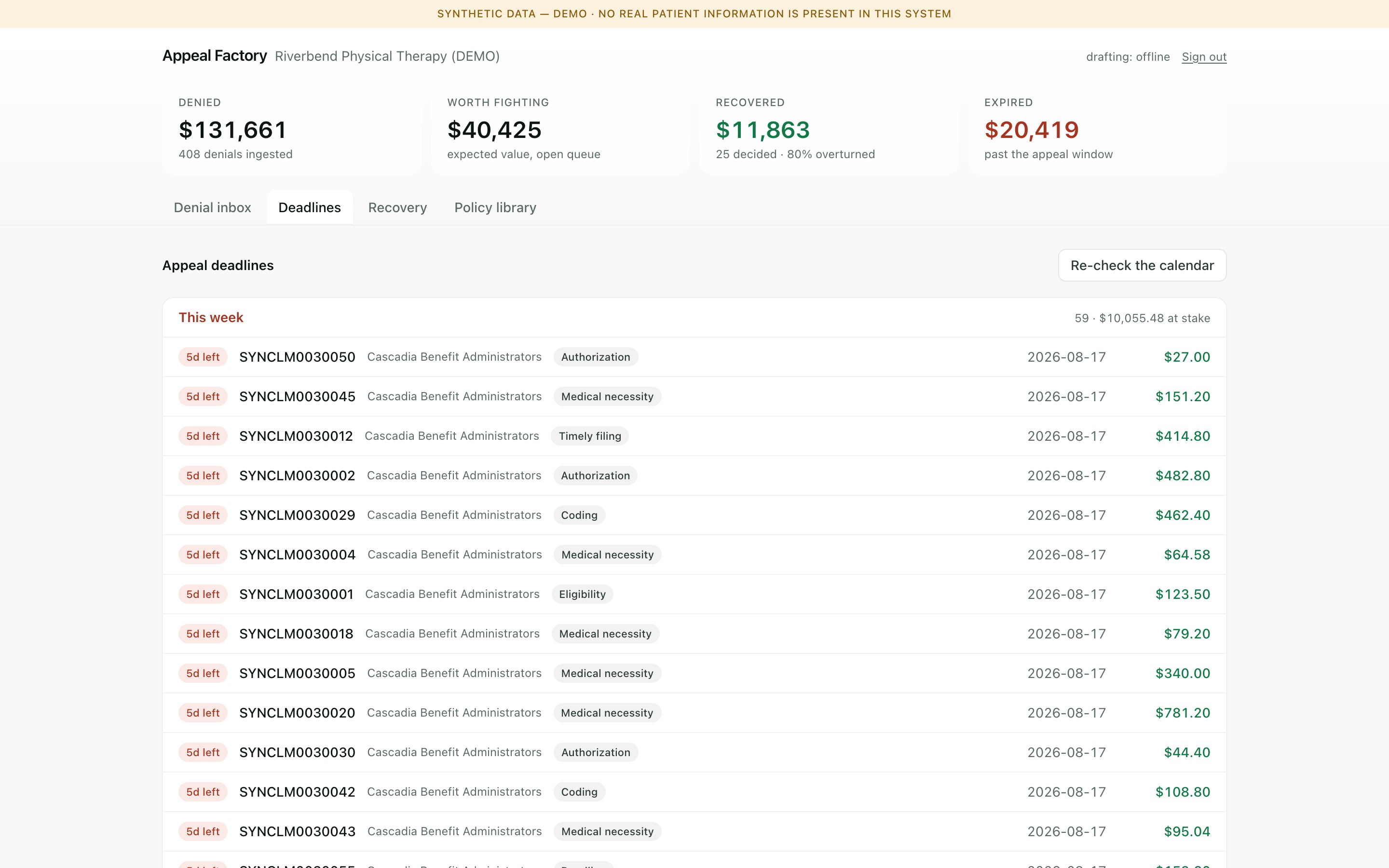
- Deadline tracking with escalating reminders, computed two independent ways
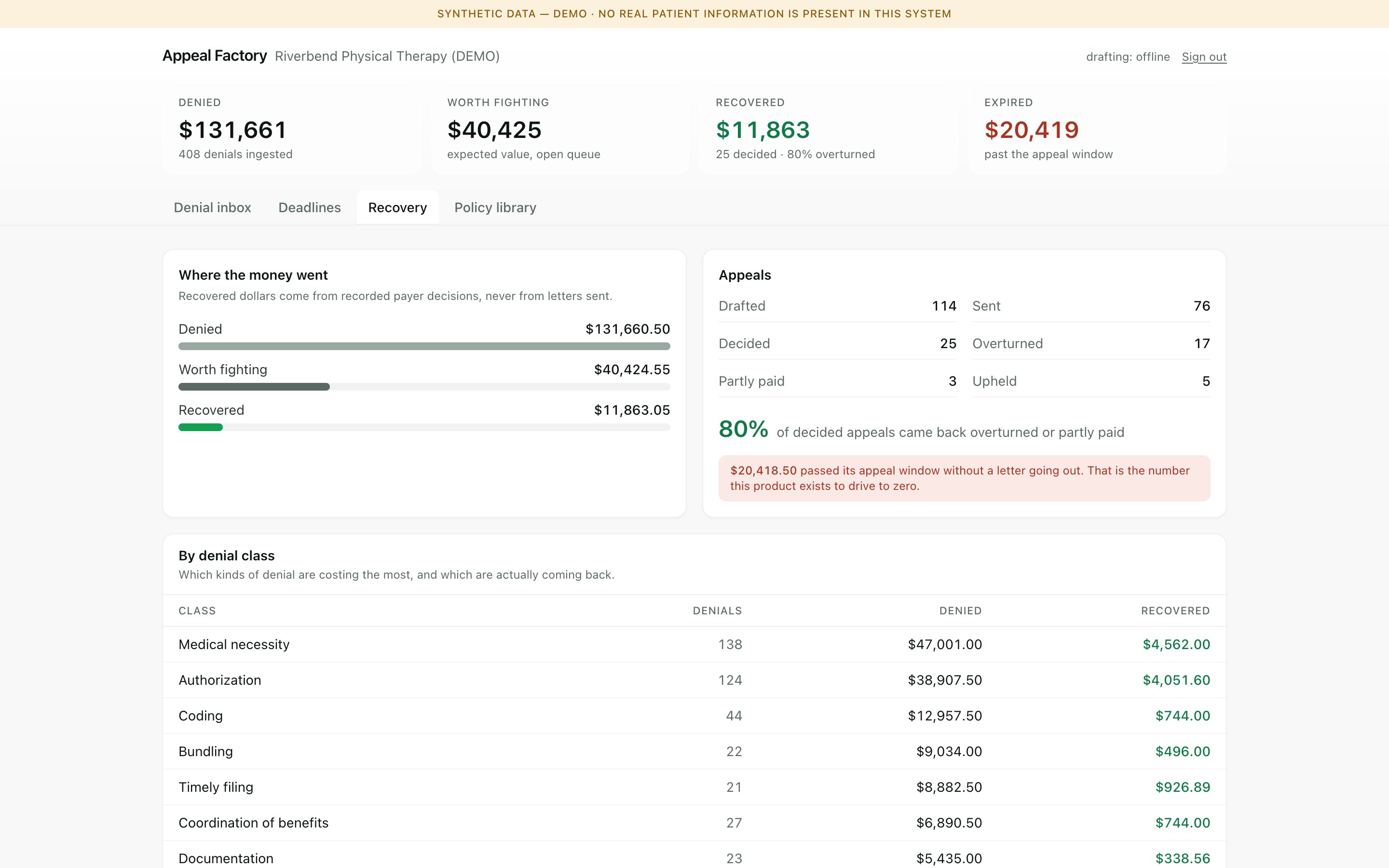
- Outcome ledger: overturned vs upheld, reported in recovered dollars
- Every draft is reviewed and sent by your biller — nothing files autonomously
4 screens · the running build
Inside the software
01 / 04
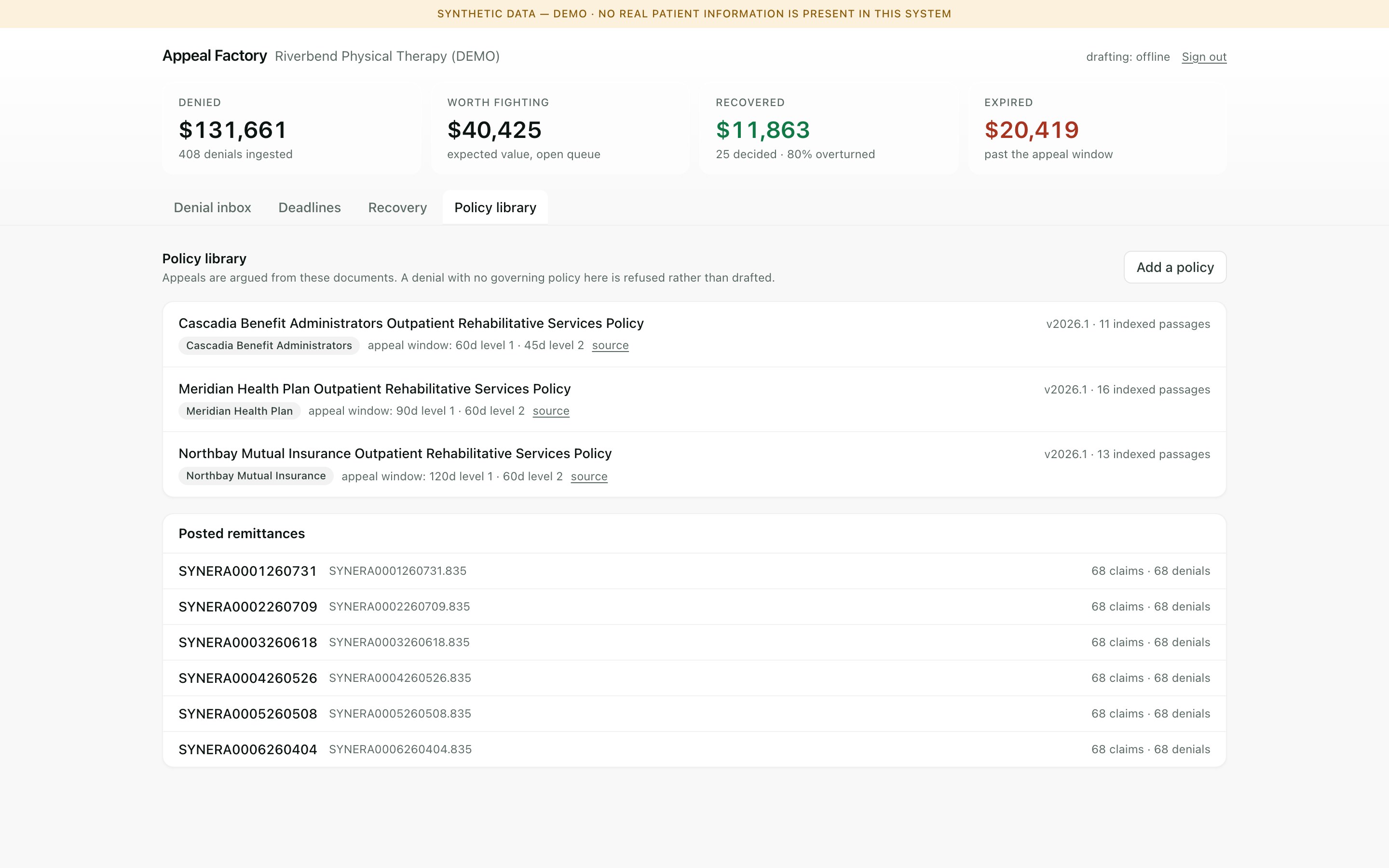
Four screens from the running build, on synthetic claim data — no real patient information has ever entered this system, and the app says so in its own header. Click any screen to read it at full size.
- 25CARC codes classified from a table, not a guess
- 2×independent deadline computations — a disagreement raises an alert
- 81.2%retrieval top-1 against a written-down expectation table
- 0letters written without a policy citation that resolves
Founding-pilot plans
Clinic
One location.
$1,950/mo
Start Clinic- One location
- Up to 150 appeals a month
- Denial classification + drafting
- Deadline calendar
Founding-pilot plan — one company, cancel anytime.
Group
Multi-location, with policy watch.
$4,900/mo
Start Group- Everything in Clinic
- Multi-location, 600 appeals a month
- Payer policy library kept current
- Recovery reporting + priority support
One company, higher volume — cancel anytime.
Network
Multi-entity with an evidence API.
$9,500/mo
Start Network- Everything in Group
- Multi-entity, unlimited appeals
- Evidence API + SSO
- Onboarding and a named contact
Multi-entity / enterprise terms — annual or monthly.
More from the store
Resolution Audit — Verify Your AI Support Bill
Your AI vendor grades its own homework. Then invoices you for the grade.
MCP Server Production Kit
The production layer every MCP server needs — OAuth, rate limits, evals & Cloudflare deploy in one kit.
Agent Skill Production Kit
The review layer every publishable Claude Code skill needs — validate, scan, ship.
Questions
Does it send appeals on its own?
No. It drafts, cites and tracks; a person on your team reviews and sends. Appeals are a legal and clinical assertion about a patient's care, and we're not willing to automate the signature on that — the leverage is in the drafting and the deadline discipline, which is where the hours actually go. The software has no send path at all; marking an appeal sent is something your biller does after they've sent it.
How does it know what the payer's policy says?
You load the policies your payers publish into the library, and every appeal is argued from them: the letter quotes the clause it rests on and names the section, and that citation is checked back against the document before the draft exists. If nothing in that payer's policy bears on the denial, the draft is refused rather than invented. The same check catches a model that writes a confident section number we never retrieved — the letter is thrown away and rebuilt from the text we actually hold.
How good is the retrieval, really?
81.2% top-one accuracy against a written-down table of which section should govern which denial code, and we ship the bench that measures it so the number can be re-run rather than believed. What that means in practice: a citation can be the wrong section of the right payer's policy, and your biller sees the quoted text beside the letter before anything goes out. What it can't be is a section that doesn't exist. That test also killed our own first improvement — weighting rare words scored worse, so it isn't in the product.
What about PHI and HIPAA?
Straight answer: it is built and running entirely on synthetic claim data, and no real patient data touches it until a BAA, an encryption-at-rest review and a hosting decision are in place. The architecture is built for that from the start — per-organisation row-level isolation enforced by the database rather than by remembering to filter, encrypted member identifiers, an append-only hash-chained log of every claim-level read — and there's a test asserting the application can't bypass any of it. But we'd rather tell you the sequence than imply a compliance posture we haven't completed.
What exactly do I get on day one?
A founding-pilot engagement, not a self-serve login. The software is built: six agents, five screens, the citation gate, the deadline calendar computed two independent ways. Week one is us wiring it to your actual remittances and loading your payers' real policies — a working session, not a signup form. Being blunt about maturity: the parser has run against hundreds of synthetic 835s and none of yours yet, and no letter from this system has been sent to a payer. That's the honest reason these are priced as pilots and why we're taking a small number of them.
Was this scoped by AI?
Yes, and here's exactly how, because it matters. Six research agents worked one domain each against a strict evidence rule: every demand claim had to come from an analyst report, a vendor's own pricing page, a dated funding round, public earnings, a named survey or a regulatory text — no forum posts, no vibes. That produced 41 candidates scored on demand evidence, contract value, how verifiable the gap was, buildability and defensibility; this one ranked second, and it's the second of the ten we've actually built. What that does NOT mean: that anyone has paid for it, or that it has run against a real payer. The research says the problem is real and expensive. Only a pilot says the product works.