Own your site
What a local business website actually costs
Three routes, five years, and the arithmetic nobody shows you — including the one where we are the expensive option.
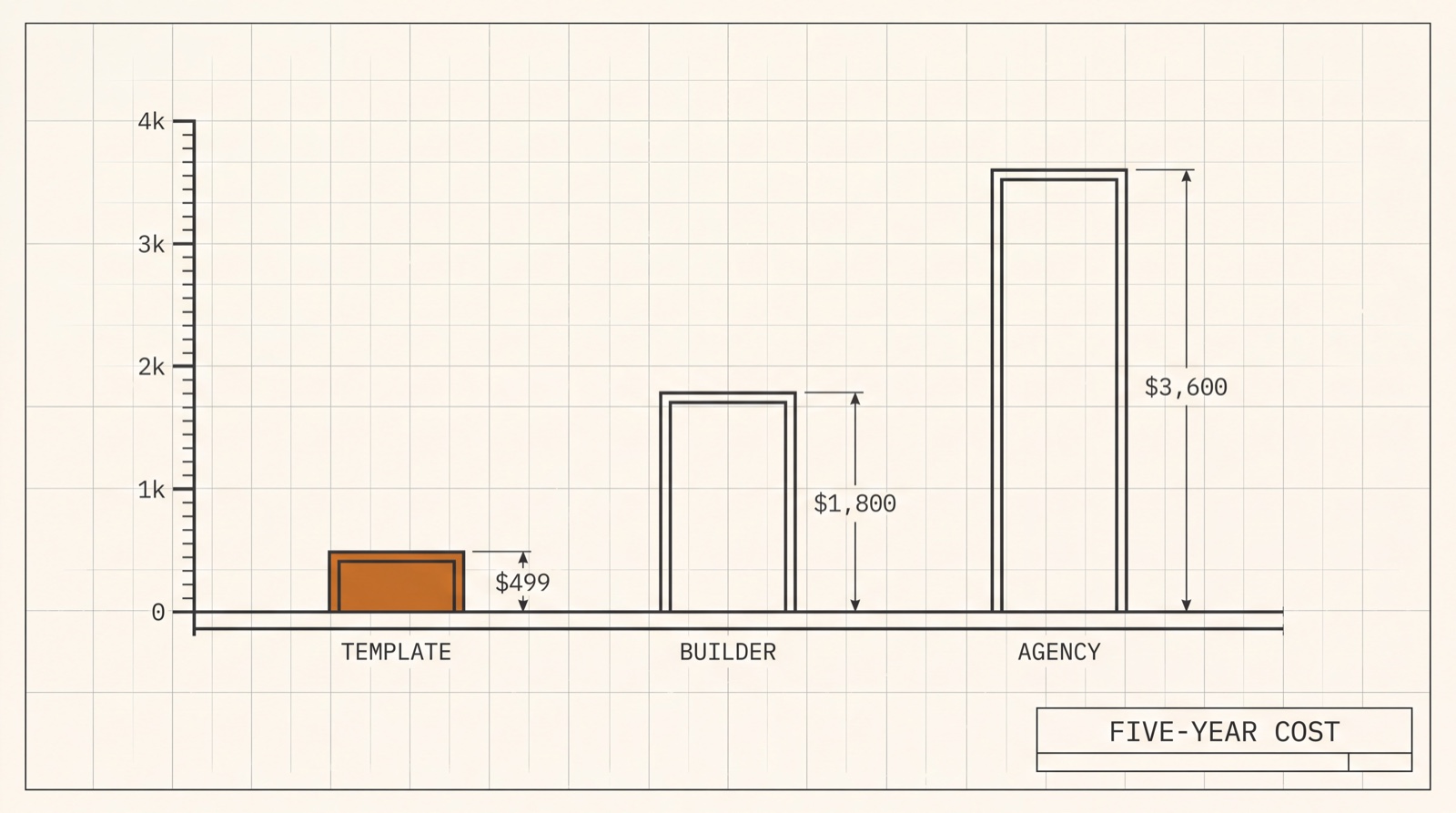
Every quote you find online answers the wrong question. Ask what a website costs and you get a build price — $500, $3,000, $10,000 — as though a website were a thing you buy once and then own, like a van. For most local businesses that is not what happens. You buy a van; you rent a website, usually without noticing, and the rent runs for as long as the business does.
So the useful question is not what it costs. It is what it costs over five years, and what you are holding at the end. Here is that number for the four routes a local business realistically has, with the arithmetic in the open so you can argue with it.
The four routes
Almost every local business ends up on one of these. They are not tiers of the same product — they are different trades made on different terms.
- Buy a template. A one-time file purchase. You edit it and host it yourself.
- Rent a builder. Wix, Squarespace, GoDaddy. A monthly fee that includes the software, the hosting and the editor.
- Buy from a reseller. SiteSwan-style local resellers: a setup fee plus a monthly fee, on their platform.
- Commission a custom build. An agency or freelancer builds it for you, to brief.
The five-year number
The chart at the top of this page compares headline prices only. The table below adds the thing every route needs and nobody quotes — a domain, roughly $12 to $20 a year.
| Route | Up front | Ongoing | 5-year total | You end up owning |
|---|---|---|---|---|
| Template | $49–$499 | $0 + domain | $124–$574 | The files |
| Builder | $0 | $16–$159/mo | $1,035–$9,615 | Nothing |
| Reseller | ~$499 | ~$50/mo | ~$3,574 | Nothing |
| Custom build | $1,900–$6,500+ | $0 + domain | $1,975–$6,575+ | The files |
| Ours, done for you | $1,500 | $0, then $149/mo optional | $1,575–$10,068 | The files |
→ Swipe the table for all five columns
Every figure above is arithmetic you can redo. Templates and the done-for-you launch are our own published prices — $49 for real estate up to $499 for the plastic-surgery Agency licence — plus $75 for five years of domain. Custom is our own rate card: Tune-Up $1,900, Rebuild $3,600, Overhaul from $6,500.
About the builder and reseller rows
Those two are not quotes and we are not going to pretend they are. Builder plans change often, differ between monthly and annual billing, and run from a starter tier to a business tier that costs several times as much — the $16 to $159 band is the shape of the market, not a price we checked for you this morning. The reseller line is the shape those offers typically take, a setup fee plus a monthly.
So do it with your own number. Open the pricing page of whatever you are actually considering, take the real monthly figure at the tier you would really need, and multiply by 60. That is the only version of this row that is true for you, and it is the one worth comparing against $124–$574.
Read our own last row honestly
Our done-for-you launch is $1,500 and includes ninety days of Care Plus. After that, Care Plus is $149 a month and you can cancel any time. If you cancel at day ninety you have spent $1,500 and you keep the files: that is the $1,575 end of the range. If you keep Care Plus for the remaining fifty-seven months you will spend about $10,068 — more than a builder, more than a reseller.
That is not a trap, it is a different purchase: hosting, backups, monitoring and change time from people who know your site. But you should go in knowing the tail exists, which is why it is printed here in the same table as everyone else's.
What you are actually buying in each case
A template buys you files and a chore
The upside is stark: the five-year cost is roughly one to two months of a builder subscription, and at the end you hold plain HTML and CSS that will still open in any text editor in a decade. There is no runtime to update, no platform to go out of business, no plan to be migrated onto. Ours are hand-written with no framework and no build step, and they host free on Cloudflare Pages or Netlify.
The cost is that you are the one who opens the file. Changing your hours means editing HTML and re-uploading. If that sentence made you tired, price in the fix — for us that is the $497 Launch Service, where we load your content and publish it once, flat fee, no subscription. Add it and the template route is still under $1,100 over five years.
A builder buys you an editor, forever
You are not overpaying for hosting. Hosting is nearly free. You are paying for the editor and the fact that nothing is ever your problem — and for many owners that is worth $30 a month without argument. The honest catch is only this: the meter never stops, and if it stops, the site does. Cancel in year four and you do not have a website with a lapsed subscription; you have nothing, and rebuilding elsewhere starts from zero.
A reseller buys you a builder with a markup
This is the route we would push back on hardest. The setup fee alone typically exceeds the entire five-year cost of a template, the monthly continues indefinitely, and you are on the reseller's platform — so you have a builder's lock-in at an agency's price. If someone local is quoting you $499 down and $50 a month, ask them one question: if I leave, what do I take with me?
A custom build buys you judgement
What you pay a good agency for is not HTML. It is someone deciding what goes on the page, in what order, and what to leave off — plus photography, brand work and integrations that no template anticipates. If your business genuinely has an unusual shape, this is money well spent and a template will fight you the whole way.
Where we are the wrong answer
We sell templates, so treat the last section as interested. This one is the correction.
- You will edit the site weekly and will not touch code. Menu changes, seasonal offers, new photos every week. Buy a builder. Paying us to relaunch every time is worse for you than $30 a month with an editor.
- You need bespoke brand and photography. A template is a structure, not an identity. If the look is the differentiator, commission the build.
- You need deep integrations. Live inventory, a patient portal, a real booking engine with staff rosters and deposits. Templates hand off to schedulers; they do not replace software.
- You have no site at all and no time. Do not buy a template that sits in your downloads folder for a year. Either buy the launch or buy a builder and get something live this week. A live mediocre page beats a perfect unopened zip.
The number that actually matters
All of the above is a rounding error next to one figure most owners never calculate: what a booked job is worth. A collision repair is four figures. A new dental patient is four figures. A home-services lead bought on Google costs $80 to $220 before anyone answers the phone.
At those numbers, the difference between a $224 site and a $1,800 site is one job. The difference between a page that gets the call and one that does not is every job.
Which is why we would rather you spent $1,800 on a site that converts than $224 on one that does not. Choose the route on the basis of who edits it and what you keep — then spend your remaining attention on the page itself, because that is where the money is. That is the subject of the next guide.
How to check this yourself
Do not take our arithmetic on faith — it is our arithmetic about our competitors. Three checks, ten minutes:
- Open the pricing page of the builder you are considering and read the annual price, not the "from" price. Multiply by five.
- Ask any monthly provider, in writing: if I cancel, what files do I receive? The answer tells you whether you are buying or renting.
- Add the domain. Every route needs one, and it is the only line item that is identical across all four.
Our own numbers live on the store, and there is a side-by-side comparison that argues the other cases in more detail. Prices there are the source of truth for the figures in this guide.
Next
Also in the Field Guide
Convert the visit · 9 min
The anatomy of a page that books work
Five parts, in order, with the reasoning for each — and the four things we take out of nearly every site we rebuild.
Convert the visit · 9 min
What a dentist's website needs that a plumber's doesn't
Three kinds of decision, three different pages — and why a template built for one trade quietly fails another.
Get found · 7 min
Being found when the search happens inside an AI
Customers are starting to ask an assistant instead of scrolling ten blue links. What that changes, and what it does not.
This, built for your trade
Every template line we sell carries the structure these guides describe — hand-written HTML you own outright from $49, with a live demo on every one. Rather not touch the files? We launch it for you.