Get found
Being found when the search happens inside an AI
Customers are starting to ask an assistant instead of scrolling ten blue links. What that changes, and what it does not.
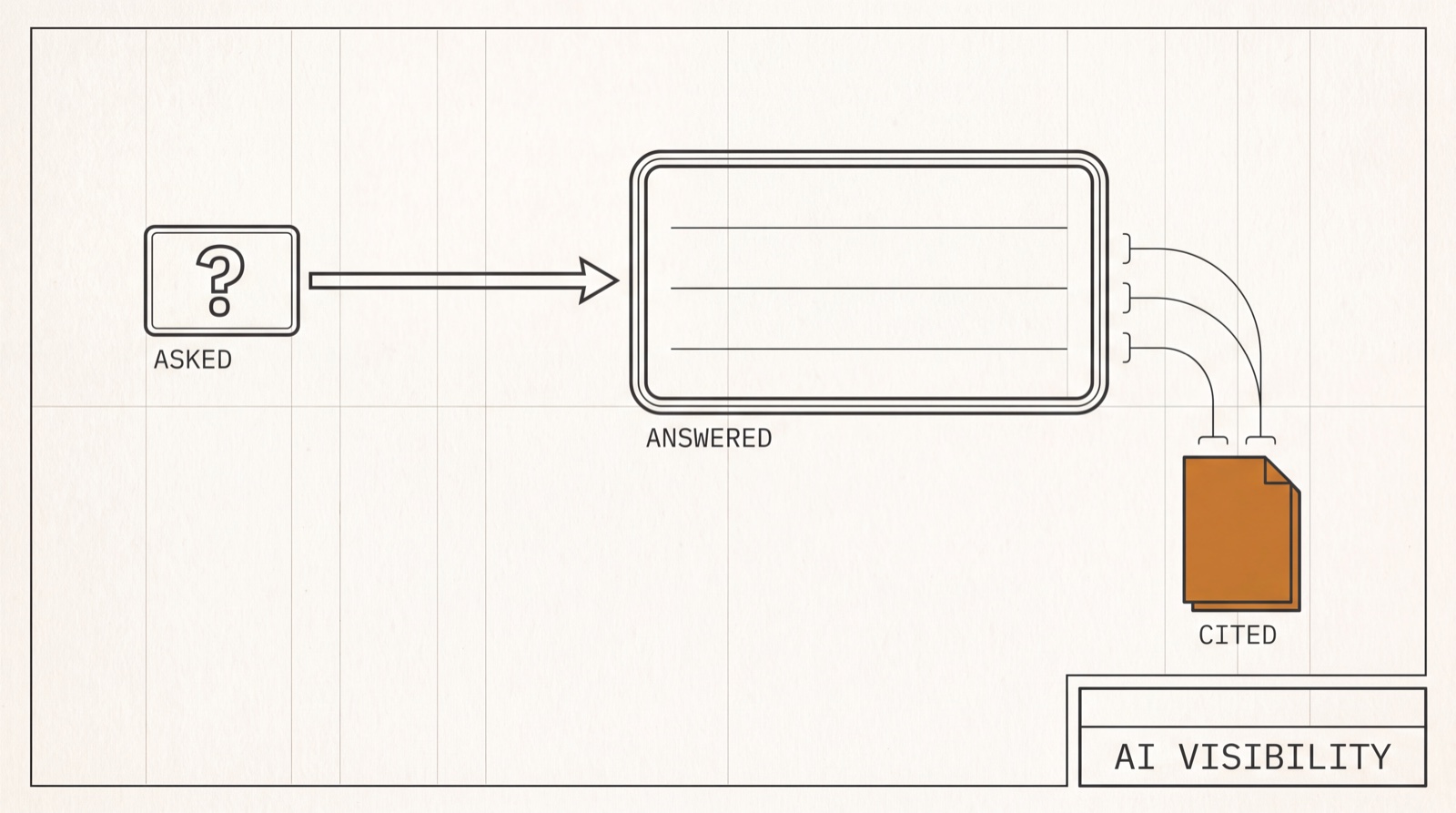
A customer who needs a body shop used to type "collision repair near me", look at a map and three links, and pick one. A growing number now ask an assistant instead — on their phone, inside a search page, or in a chat app — and get a paragraph back naming two or three businesses. They never see a results page at all.
That is a real change and it is worth understanding properly, because the advice around it has gone straight to snake oil. There is no way to buy a place in an answer, no setting to switch on, and nobody who can guarantee you a mention. What there is: a set of conditions that make you a usable source rather than an unusable one. Those are worth your attention, and they are almost entirely things you should have been doing anyway.
What actually changed
One thing, mostly: the number of businesses shown has collapsed. A results page lists ten links and a map pack of three, and a curious customer might click four. An answer names two or three and often no more. Being eleventh used to mean less traffic; being outside a short list now means none.
The second change is subtler. A link asks the customer to judge you. An answer has already judged you — it summarises your reputation in a sentence before you get a word in. If your reviews mention slow callbacks, that is the sentence.
What did not change
Assistants are not consulting a secret index. They are reading roughly what everyone else reads: your Google Business Profile, your website, your reviews, directory listings, local news. The inputs are the same as they were for local search. Anyone selling you "AI optimisation" as a separate discipline is selling you local SEO with a new invoice.
The six things worth doing
1. Treat your Google Business Profile as the primary site
For a local business it carries more weight than the website: categories, services, hours, service area, photos, reviews. It is also the most commonly neglected — hours wrong after a holiday, a category left on whatever was picked in 2019, half the services blank. Fix that first, before touching anything else. If your profile and your website disagree, you have taught every system reading you that you are unreliable.
2. Make your facts identical everywhere
Name, address, phone, hours — byte-identical across your site, your profile and every directory you appear in. Not "close enough". A suite number in one place and not another is enough to look like two different businesses. This is dull, unglamorous work and it is the highest-value hour you will spend.
3. Write things that can be quoted
A system assembling an answer needs a sentence it can lift. That favours plain, factual, self-contained statements over marketing prose. "We are I-CAR Gold certified and work with all major insurers; same-day estimates Monday to Friday" is quotable. "Your trusted partner in automotive excellence" is not — it makes no claim, so there is nothing to cite.
The practical version: for every question a customer asks on the phone, put the answer on the site as a short paragraph that stands alone. That is the whole trick, and it is why pages like this one exist.
4. Publish the specifics nobody else bothers with
Which insurers you are approved by. Which brands you are certified on. Your actual response window. The towns you cover and the ones you do not. Specificity is what makes you the answer to a narrow question — and narrow questions are the ones assistants get asked, because a customer typing to a chatbot writes far more than they would type into a search box.
5. Mark up the facts in machine-readable form
Structured data — a LocalBusiness block with your hours, location and phone, and
an FAQPage block on pages that answer questions — states your facts in a format
that needs no interpretation. It is not a ranking trick and it will not rescue a thin site.
It removes ambiguity, which is the only thing it claims to do. Our templates ship with it in
place; if yours does not, it is an afternoon.
6. Keep reviews recent and specific
Recency does more work than volume past a certain point, and specific reviews are more quotable than glowing ones. A customer writing "they matched the pearl white on a 2019 Mazda and had it back in three days" has written your marketing copy in a form that gets repeated. Asking for that kind of detail — "would you mind mentioning what we fixed?" — is more useful than asking for five stars.
What we will not claim
We cannot get you cited by a named assistant, and neither can anyone else. These systems are opaque, they change without notice, and they disagree with each other about the same business on the same day. Anything framed as a guaranteed placement in an AI answer is a guess wearing a suit.
What is defensible: the six items above make you a more usable source, they are all verifiable by you, and they pay off in ordinary search regardless of what assistants do next. If AI answers stalled tomorrow, none of that work is wasted.
How to see where you stand
Do this yourself before paying anyone, including us. Open a fresh browser session so you are not being shown your own history, and ask an assistant the three questions your customers actually ask — "best collision repair in [your town]", "who does [your service] near [your town]", "is [your business name] any good". Then write down what comes back.
- Are you named at all?
- If you are, is what it says about you true and current?
- Who is named instead of you, and what do they publish that you do not?
That third question is usually the whole answer. In most audits we run, the competitor being cited is not better at marketing — they have simply written down more facts.
If you would rather have it done properly, our AI Visibility Audit is $149: captured answers and local-pack results for your terms, a comparison against the competitors being named instead, and a prioritised fix list, back in two business days. The $149 is credited in full against anything you buy afterwards, so if it turns into a build you have paid nothing for the diagnosis.
Next
Also in the Field Guide
Own your site · 8 min
What a local business website actually costs
Three routes, five years, and the arithmetic nobody shows you — including the one where we are the expensive option.
Convert the visit · 9 min
The anatomy of a page that books work
Five parts, in order, with the reasoning for each — and the four things we take out of nearly every site we rebuild.
Convert the visit · 9 min
What a dentist's website needs that a plumber's doesn't
Three kinds of decision, three different pages — and why a template built for one trade quietly fails another.
This, built for your trade
Every template line we sell carries the structure these guides describe — hand-written HTML you own outright from $49, with a live demo on every one. Rather not touch the files? We launch it for you.