Signal Foundry · TypeScript + research kit
Signal Foundry — AI Product Studio Kit
The 40 hours before your first prompt — research, architecture, and an app that refuses to make things up.
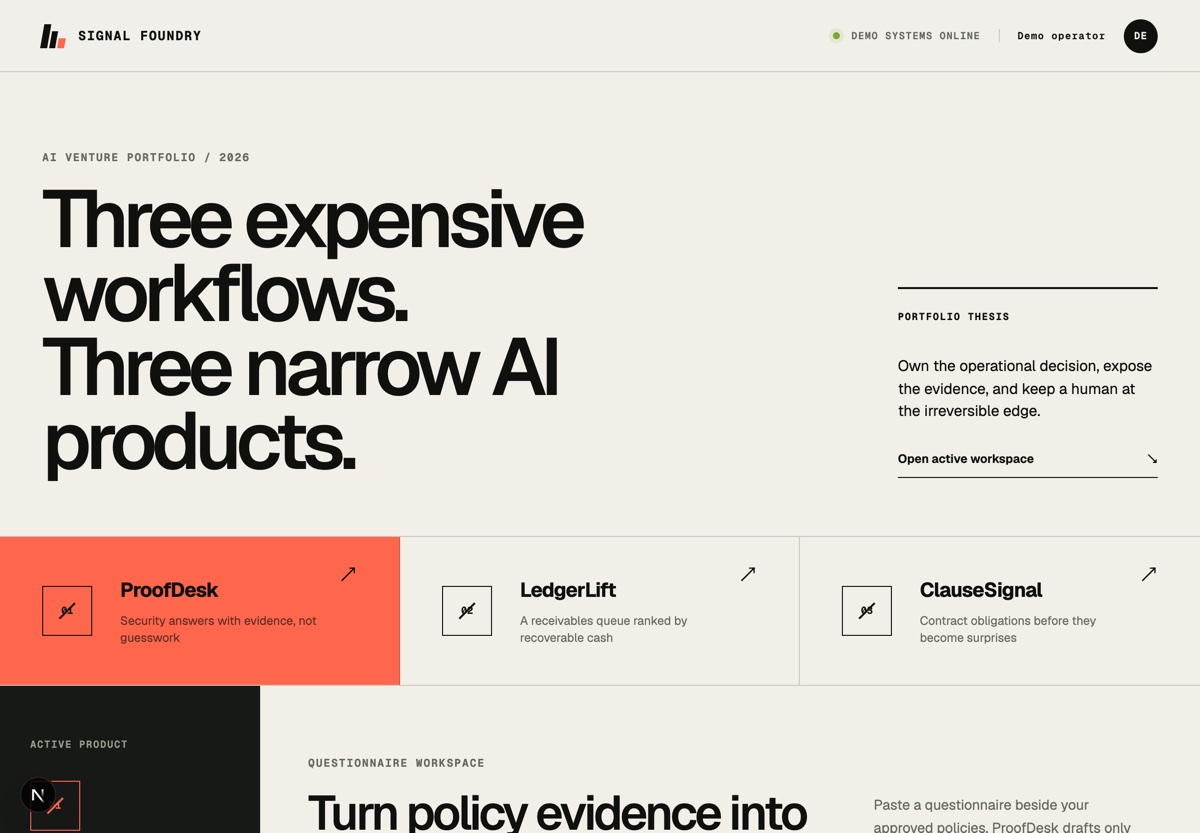
Most AI starters hand you a chat box and leave the hard parts as an exercise: what to build, why anyone pays for it, and how to stop the model inventing an answer when the source doesn't have one. This kit is those three parts. Twenty B2B opportunities scored against a rubric with a dated, linked evidence register behind every demand claim. Three of them written up as full product briefs — buyer, golden path, pricing hypothesis, 30-day validation plan, and the kill criteria that tell you to stop. And a working Cloudflare app implementing all three on one evidence-first engine: it answers security questionnaires, ranks overdue invoices, and extracts contract obligations, and every finding it marks ready carries a quote copied character-for-character from the document — or it comes back blocked. That rule is enforced in code, not just in the prompt: a response that claims something the source doesn't support gets sent back to the model once, and fails the run rather than shipping.
Built for: Founders, consultants and agencies deciding which B2B AI product to build — and wanting the safety architecture already done
- 20 B2B AI opportunities scored on a weighted rubric, with a 20-source dated evidence register
- Three full product briefs: buyer, golden path, pricing, 30-day validation plan, kill criteria
- A working Next.js 16 + React 19 app on Cloudflare Workers + D1
- Real Claude integration — structured outputs, prompt caching, one schema-repair retry
- The evidence gate enforced twice: in the prompt, and again in code
- Prompt-injection-resistant document envelope, with the test that proves it
- Threat model, eval gates, and the multi-tenant schema evolution mapped out
- 17 tests green on a clean-room install — no API key needed to run them
- 20opportunities scored
- 17tests green, clean room
- 3products, one engine
Pick your license
Founder
One developer, one product of your own.
$149
- The full research + architecture + code kit
- Real Claude provider, wired
- 12 months of updates
One developer building one product.
Team
Your whole team ships with it.
$299
- Everything in Founder
- Team-wide license
- Priority email support
One team, internal and commercial products.
Agency
Unlimited client products.
$599
- Everything in Team
- Unlimited client builds
- Source design files where provided
Unlimited client products.
14-day money-back guarantee — if the kit doesn't fit your stack, reply to your receipt within 14 days and we refund it in full. Keep nothing, owe nothing.
More from the store
Relay — Autonomous SDR
The AI SDR that can't make things up.
ReconBridge — CRM↔ERP Reconciliation Agents
Your integrations move data. Nothing proves it arrived right.
Appeal Factory — Denial Appeals for Providers
70% of fought denials get overturned. Most never get fought.
Questions
What exactly do I get?
An instant download of the whole kit: docs/RESEARCH.md (20 opportunities scored on a weighted rubric, a 20-source evidence register with dated links, a ten-row pre-mortem, and the reasoning for what got cut and why), docs/PRODUCTS.md (three product briefs with buyers, golden paths, pricing hypotheses, a 30-day validation plan and explicit stop criteria), docs/ARCHITECTURE.md (containers, prompt layers, the D1 schema and its multi-tenant evolution, a threat-model table and the release gates), and the full application source — Next.js 16, React 19, Cloudflare Workers, D1 with Drizzle, the Anthropic provider, and the test suite. npm run eval runs 17 tests; they were green on a clean-room install from this exact zip.
Does it actually work, or is it a demo?
Both, deliberately, and the difference is labelled everywhere. With no API key it runs in bounded demo mode: deterministic keyword rules over three bundled sample documents. That mode is a demo — it recognises the samples and little else, and the UI says so. Set ANTHROPIC_API_KEY and it analyzes documents it has never seen. We verified that before listing: on a security questionnaire using none of the demo's hardcoded controls it answered the two supported questions with verbatim citations and blocked the third for lack of evidence; on an invoice ledger with unfamiliar headers and non-standard IDs it parsed every row, ranked by recoverable cash and routed the disputed one to review. That transcript is reproducible with npm run eval:live.
What's the evidence gate, and why does it matter more than the code?
It's the one rule that makes AI output usable in a room with a lawyer in it: no source, no answer. Every finding marked ready or review carries a quote copied character-for-character from the document. When the source doesn't support a claim, the finding comes back blocked with an empty evidence array and a note saying what's missing — the model is never allowed to fill the gap from background knowledge. The prompt states the rule; the provider then re-checks it after parsing, hands a violating response back to the model once, and fails the run rather than shipping an unsupported claim. Anything contractual or irreversible stays behind a human gate even when the evidence is strong.
Which model, and who pays for the tokens?
It defaults to Claude Opus 5 and you bring your own Anthropic key — we don't resell model access, so tokens are billed to you at Anthropic's rates. Swap the model with one env var and the reasoning depth with another; the per-product policy prompt carries a cache breakpoint, so repeated runs re-read it at cache rates. There's also a gateway provider if you'd rather route through your own endpoint and own model selection, logging and retention yourself.
What isn't finished?
Two things, both written down in docs/VALIDATION.md rather than buried. First: we hold no Anthropic key on the build machine, so while the request shape, parsing, retry and every failure branch are tested against a mocked transport, and the prompts are tested against a real model, the live HTTP call to api.anthropic.com has never been run as one piece here. Set your key and run one analysis before you trust it in production. Second: because of that, cost-per-run and P95 latency are targets in the architecture doc, not measured results. Everything else — lint, types, 17 tests, the production build — is green from the zip you download.
Was this made by AI?
The research, briefs and application were produced with heavy model assistance and then verified by hand before listing — and unlike our engine-scouted kits, this one didn't come out of a scored tournament, so we won't claim it did. What we did instead is test the claim this listing rests on: that it analyzes real documents rather than only its own samples. It does, and the check is in the box.